Do rooks have an ancestral awareness and maps of significant places? John Billingsley is transported
A familiar sight as the light thickens at the end of day are streams of corvids – rooks and jackdaws – skeining overhead as they head towards their night’s roost. It is a flight full of direction and purpose, and always ‘as the crow flies’ – i.e. straight to the destination. It is a glorious sight to be near the roost and watch as hundreds, more usually thousands, of birds fly in from the surrounding countryside, jackdaws clamouring irrepressibly, rooks too seeming full of news to impart to their fellow birds. They fascinate me, rooks, and I find myself standing under rookeries and roosts as they chatter, straining to eavesdrop on what is quite obviously a conversation at end of day. This is pretty much the only time they’ll hang about in trees – they are grassland birds, enjoying wide views, and they are a perennial sight at Stonehenge, where they seem avian custodians of the stones. Indeed, many henges and hillforts would feel deserted without their rooks.
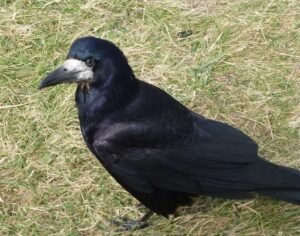
The rook’s mysteries only deepened for me when I read a perceptive book by another rook-ophile, Mark Cocker.1 Roosts, he told me, are mostly a thing of winter; rookeries are where they head off to when they nest and breed. Fair enough – but they are not so separate as that may seem, for some roosts were once rookeries, and rooks have patterns of attachment to places. No great surprise, this, for after all many birds return annually to their customary breeding site – but the roosts are dormitories, and are close to rookeries or had once been rookeries – ‘these crossroads in the landscape… held the necessary aura of sanctity for corvids to wish to rest there for the night’.2
Moreover, it seems that some birds on the way to their nightly roost like to return to rookeries where they were born or where their ‘line’ was breeding some time previously, a tradition presumably handed down between generations. This applies even when a rookery has fallen into disuse – a kind of ‘ghost’ rookery, rook hauntology.
As I write this in mid-February, about an hour before sunset, I look out see dark shapes sitting here and there in the bare branches of a small wood that in a few weeks will become the scene of nest-building and the reactivation of a rookery; and at the end of summer it will be the hub for gatherings of several thousand birds streaming in from points of the compass, wheeling in the air above the trees and making an excited hubbub of jacks, daws, and craas. Now, though, those dark shapes are sitting spaced apart, alone, and silent, as if meditating – were these birds born in these trees, does this place hold some kind of special memory for them?
There is something positively ancestral in this behaviour, and a nagging human impression that rooks have their equivalent of sacred sites, as Cocker lets slip in the previous quote, is expressed by the birds in their rookeries and roosts, and indeed by their journeys between them. And the conventional name for the community that works its way around a number of interlinked sites, making up an apparent sense of a social network, is a parish of rooks.
It’s not just these high arboreal places of safety that are apparently Significant Places, either. For there is usually somewhere – a field, not trees, near the roost – where rooks and jackdaws foregather, converging in small groups, before they head off en masse to their roost. The day has been for foraging; the twilight draws them together in a gathering that sounds like an exchange of corvid-relevant news, and when the light hits a certain level, it’s bedtime – all off to the trees.
This is what we see from our level. Birds flying in, from where we can’t see – just a kind of black tunnel opening in the air towards us, alighting on the ground, flying up into trees and staying while the dark persists; and when the light returns, off again. In small groups and pairs, they fly off, across the horizon, somewhere we can’t see, and then throughout the day we’ll bump into them here and there in fields, on wires, in the air, and in the late afternoon, when it was time for farm labourers to knock off, there are those lines of corvids above us, pursuing their straight course.
Cocker credits Franklin Coombs with observing that ‘from an average height above the rookery of about 30 metres, 80-90% of the birds [in his local Cornish ‘tribe’ or parish] could actually see their night-time destination’, and the same held true for Cocker’s Norfolk community – ‘from a similar elevation, and certainly from 100 metres – no great height for a roost-bound rook – the whole Yare-valley population was in direct visual contact with almost all its constituent parts… how radically different’, he writes, ‘was this country as seen from above. From horizon to horizon the landscape became at one smaller but freer, more unified and yet more fluid… the rooks’ [geographical sense] was one where significance was unevenly distributed across the countryside. It was framed by a network of points loaded with psychological meaning’.3
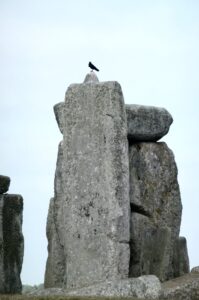 And in this I see an echo of our neoantiquarian fascinations, and not just because I can’t imagine Stonehenge without rooks. Cocker’s quote echoes in my mind a passage from Paul Devereux: ‘We are dealing with what has been called a “cognised landscape”, whether we are dealing with fairy paths in Ireland, songlines in Australia, ritual roads in the Americas, or death roads in Europe. They all represent the mapping of mindscapes that were projected on to the physical landscape in past times’.4 And that seems to me the rooks’ relationship with their landscape – a fluid pattern of aerial routes wherein linger their very own spirit paths.
Our grounded human perspective, punctuated by trees, sightlines and horizons, breaks up the rook experience into separate episodes. But from an airborne rook’s eye, it is all connected, and its places of meaning are connected too, as the crow flies, by straight lines of flight between sites of gathering, of reflection and of tribal regeneration and celebration. A ley-hunter would find it familiar, but a ley-hunter is grassbound, poring over a map.
Yet at times when we neoantiquarians contemplate a landscape, the spirit soars. Alfred Watkins’ revelation of sites across the countryside linked by the invisible straight paths he came to call leys was a rook’s-eye view.
Dedicated to the memory of Brian Taylor, 1948–2018.
Earlier versions of this article appeared in Noods Radio zine, Bristol, 2018, and NE154, Sept. 2018
Notes
1. Crow Country, Jonathan Cape 2007.
2. Cocker, p132.
3. Cocker, pp130–131.
4. Fairy Paths & Spirit Roads, Vega 2003, pp11–12.