This article was first published in NE175, March 2024.
Is the daisy wheel always a protective sign? Anthea Hawdon suggests another interpretation
In 1686 the antiquarian and Fellow of the Royal Society, Robert Plot, described a carved perpetual calendar in his Natural History of Staffordshire.1 This wooden almanac marked each saint’s day with a symbol carved on one of the four edges of the block. Among the swords denoting beheadings, griddles and wheels for more imaginative ways of martyrdom, there was this symbol.
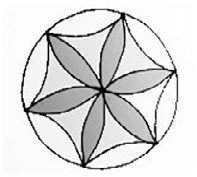 Fig. 1 Lover’s Knot
This particular form of rosette was carved on 14 February for St Valentine.
Plot described it as a ‘true lover’s knot’. This may be surprising to some, because when this symbol shows up in graffiti research it is usually interpreted as having an apotropaic function.1a Yet here is this symbol used to indicate a day dedicated to romantic love, and described as such by a person who is contemporary with its use.
It is the purpose of this paper to show that this ‘lover’s knot’ meaning has been hiding in plain sight in many domestic settings and this meaning should inform the interpretation of this symbol where a protective function is not obvious.
Furniture
Perhaps one of the most important considerations in furniture and other interior decor items is that the item in question is decorative, that it pleases the eye of the owner, if not that of every beholder. In the case of the daisy wheel rosette or the lover’s knot rosette, it is difficult to argue that they are not decorative and pleasing to the eye as well as simple and satisfying to produce. There is a reason that practically every child when learning to use a set of compasses quickly learns to produce the six-petalled daisy wheel shape.
We should therefore not be surprised that they appear on many items of furniture across many ages and cultures. Esther Grobler’s collection2 has examples from Ancient Egypt to Sumer to Babylon. While some examples have ritual use, there are some, such as an Iron Age Anatolian cosmetics box, where adding a ritual meaning makes less sense. Does make-up need protection?
In Early English and Welsh domestic furniture, the lover’s knot (and the daisy wheel) appears in several items, mostly chests and chairs, but they are only one of many decorative motifs used and it must involve special pleading to say that these motifs have a protective function when so many other designs do not. Richard Bebb’s study of Welsh furniture has an example where the lover’s knot appears on a chair back with another daisy wheel and a design made up of hearts.3 And if they have a function in addition to being merely decorative, then they should not be as subject to the whims of fashion as other designs. But that appears to be the case. The pattern books of Sheraton4, Hepplewhite5 and Chippendale6 may have some rosette designs, but the simple, compass-drawn daisy wheel does not appear in any of these 18th-century pattern books.
It is always tricky to infer meaning from the absence of something, but if the main purpose in carving a daisy wheel in furniture was apotropaic, we should expect to see it in many more liminal places, such as fire surrounds or mantelpieces, and it’s just not there in the examples that have survived, such as those detailed by Cescinsky and Gribble in Early English Furniture and Woodwork.7
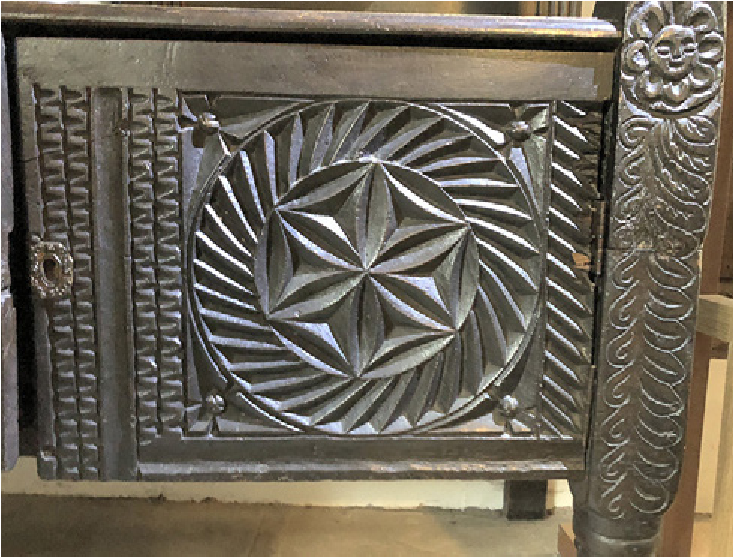
Fig. 2 – Cabinet, 1620s house, Coalville, Leics.
Love spoons
Potentially the most famous of the carved wooden love tokens are the Welsh love spoons. These wooden spoons were never intended to be used, but were carved to show the esteem and affection held by the carver for their lover. NE Roese’s research has shown that these spoons are probably not as widespread a practice as modern sensibilities would like to make out.8 However, they were carved, and the lovers’ knot rosette symbol appears among other symbols for love, marriage and home.
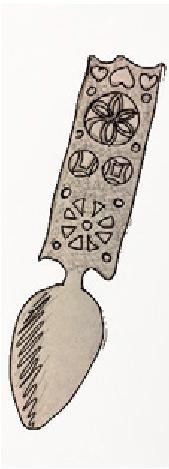 Fig. 3 Love Spoon
– National Museum Cardiff
If you research the meaning of the various symbols used in making the love spoons, the modern interpretation is usually given as a ‘wheel’, although Roese does separate the lover’s knot from the wheel symbol. The knot symbol seems to have disappeared from the current store of symbols used in contemporary lovespoon carving, but is very prevalent on older spoons in museum collections.
Kitchen equipment
The rosette symbol can also be found on many small moulds used in kitchen work. Butter pats and cheese moulds frequently display this motif. The purpose of this was to either identify the producer of the butter or cheese or as decoration when displayed on a table. Considering the multiplicity of designs used especially for butter moulds or pats,9 then again special pleading must be employed to say that the rosette has more meaning than say, a cow or a strawberry, which are also common motifs for this purpose.
Knitting sheaths
Knitting sticks or knitting sheaths are a piece of everyday technology designed to make fast knitting easier. In the days before commercially-made knitting needles were available, knitting was done on shorter, thinner needles (or wires, as they were sometimes called) that were open at both ends. It makes the knitting quicker if the right-hand needle can be steadied. Sometimes knitting belts were used with holes where one end of the needle could be stuck. The main alternative to that method was to use a wooden knitting stick or sheath. This was a bent length of wood that could held under the knitter’s right arm, and it had a holder at the front where the knitting needle could be stuck and held firm.
These knitting sticks could be made of many different materials including bone, brass and horn, but wood was the most common. In many cases, this wood is decorated with chip carving. These practical objects could be turned into tokens of love when carved by a young man for his sweetheart.10 Hearts are common motifs, as are initials and dates with the occasional line of romantic text, but nestled among them can be found this form of rosette.
There does not appear to be any kind of apotropaic context for this symbol among the knitting sheaths. Knitting is something entirely under the control of the knitter. There is no magic involved in knitting. It is not something that appears to be easily influenced by supernatural entities. It seems unlikely, then, that any kind of protective symbol would be needed. It seems much more likely that in this very domestic context, the rosette stands for love or decoration rather than an endless loop symbol trying to keep evil spirits at bay.
Stay busks
Of all the small, carved items of history, few can be more intimate than the busk. In the days before the modern corset was developed, women wore stays or bodies to support and mould their torsos into the fashionable shape of the time. Stays and bodies were laced down the back or side, and once the woman was wearing them, a thin piece of wood, bone or baleen was slid down an opening at the front. This finished off the stays and kept the fabric taught and straight over the abdomen. This finishing piece of wood was the busk.
This piece of wood was worn next to the woman’s shift, next to her heart – or between her breasts, depending on how you view matters. Inevitably they were going to be given as love tokens by suitors and husbands. Valerie Steele lists several examples where this is so.11 Hearts are a very common motif. Declarations of love are also fairly common, including some with verses ranging from the sweet to the naughty, where some men regard the busk as a placeholder for the time when they themselves can lie so close to their loved one’s bosom.
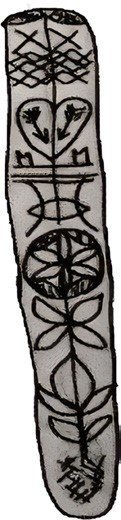 Fig. 4 18th century stay busk – National Museum of Scotland
It could be supposed that an item so personal and intimate might have a use as a means of protection against malign spirits, but this seems not to be the case. Love, not protection, seems to be the order of the day. Amongst these carved thoughts of love and sex, the lover’s knot rosette can surely take its place as another love symbol, not as a demon trap.
It is not the purpose of this paper to argue that the daisy wheel is never used to promote
good luck or as a means of ritual protection. There is enough evidence from such researchers as Timothy Easton12 that a daisy wheel graffitied onto a door, doorframe or windowsill can be assumed to have a protective function. However, a similar motif incorporated into the design of a piece of furniture or household object with no liminal role does not carry such a weight of protective inference. Caution should be employed when assigning ritual protection roles to motifs that may symbolise love and home or just pure decoration in a domestic setting.
Notes
- Plot,R. The Natural History of Staffordshire. 1686.
- Easton, Timothy. ‘Apotropaic Symbols and Other Measures for Protecting Buildings against Misfortune’. Physical Evidence for Ritual Acts, Sorcery and Witchcraft in Christian Britain: A Feeling for Magic, ed. R Hutton, Palgrave Macmillan 2015, pp.39–67.
- Grobler, Estelle Cornelia. The Rosette Symbol in the Ancient Near East: An Iconographic Approach. 2021. Thesis. uir.unisa.ac.za, https:// uir.unisa.ac.za/handle/10500/29212.
- Bebb, Richard J. Welsh Furniture 1250-1950: A Cultural History of Craftsmanship and Design. Saer Books, 2007.
- Sheraton, Thomas. Thomas Sheraton’s The Cabinet-Maker and Upholsterer’s DrawingBook. Praeger, 1970.
- A Hepplewhite and Co. The Cabinet-Maker and Upholsterer’s Guide, or, Repository of Designs for Every Article of Household Furniture, in the Newest and Most Approved Taste: Displaying a Great Variety of Patterns … in the Plainest and Most Enriched Styles : With a Scale to Each, and an Explanation in Letter Press : Also, the Plan of a Room, Shewing the Proper Distribution of the Furniture… 3rd ed. Improved, re-printed and published by B T Batsford, 1897.
- Chippendale, Thomas. The Gentleman and Cabinet-Maker’s Director: Being a Large Collection of the Most Elegant and Useful Designs of Household Furniture, in the Most Fashionable Taste. 3rd ed., John Tiranti Ltd, 1939.
- Ernest R. Cescinsky, Herbert &. Gribble. Early English Furniture & Woodwork: 2-Vol. Set. George Routledge & Sons, 1922.
- N E Roese. ‘Lovespoons in Perspective’. Bulletin of the Board of Celtic Studies 35, 1988, pp.106-15.
- Pinto, Edward H. ‘Correspondence: for printing on butter’. Country Life (Archive: 1901-2005), Vol. 112(2900), 15 Aug. 1952, p.469. Country Life Archive, 1542786515.
- Ian McFeeters. Knitting Sticks & Sheaths:A History. Bleasdales, 2016.
- Steele, Valerie. The Corset: A Cultural History. Yale Univ. Press, 2001.
- Easton, Timothy. ‘Church Apotropaic Symbols and Marks Of Piety’. Material Religion 11(4), Oct. 2015, pp.575–77.